
Quantity Takeoff Methods Every Estimator Should Know
Togal
|
The quantity takeoff methods estimators use today fall into three groups: manual takeoff from paper plans, click-based digital takeoff on screen, and AI-assisted digital takeoff.
Manual still works for smaller projects with a single scope. Digital methods pull ahead once plan sets grow, revisions stack up, or several estimators touch one bid. The biggest difference between them is where your hours go: measuring, or reviewing what was measured.
Every method feeds the same estimating process, so your choice shapes cost estimation, project planning, and how many bids your team can chase.
For a refresher on the steps themselves, start with this guide to the construction takeoff process. Knowing how each method spends your hours helps you make informed decisions on each construction project, from construction planning through bid day.
What Are the Key Components of a Quantity Takeoff?
Whatever the method, a quantity takeoff involves measuring five kinds of key quantities from the drawings and specifications:
- Counts: doors, windows, fixtures, and equipment
- Linear: wall runs, trim, base, and piping
- Area: floor finishes, ceilings, and wall area for paint or drywall
- Volume: concrete for slabs, footings, and walls
- Weight: aggregate and fill by the ton
In civil engineering and quantity surveying, a quantity surveyor often turns these into a bill of quantities. In building construction, the takeoff feeds cost estimating, where labor rates and market rates turn quantities into a total cost. Estimators run most takeoffs on a bid: at a general contractor across every scope, and at a subcontractor for their own trade.
Manual Quantity Takeoff: The Takeoff Sheet and the Scale Ruler
Manual takeoff is the oldest method: paper plans, a scale ruler, highlighters, and a takeoff sheet where you record every count and measurement by hand.
Manual still makes sense for several reasons. It costs nothing to start and handles a single-trade job with a handful of sheets. It also teaches newer estimators to read drawings in detail. Orillia Drywall notes that on straightforward residential drywall jobs, traditional takeoffs are often fast enough on their own.
The limits show up with size. Effort grows with every sheet, and every revision means measuring again. On a large construction project with multiple scopes, the takeoff sheet becomes the bottleneck.
"Tracing every wall by hand taught me to read the whole set before I trust a single quantity. On high-rise jobs, the sheets don't always agree with each other, and you only catch that if you look. I still do that read on every takeoff the software gives me; the measuring got faster, the reading didn't."
Johnny Maghzal, Head of Growth at Togal.AI and former estimator
Digital Quantity Takeoff and the Click Problem in the Takeoff Process
Click-based digital takeoff moved plans onto the screen. Tools that arrived in the 1990s and 2000s let you measure from a PDF, apply scale automatically, and export quantities to a spreadsheet.
Model-based takeoff is a related digital method that pulls quantities from a BIM model. It works well when a complete, current model exists. When the bid set arrives as PDFs, you are back to drawing-based takeoff.
Click-based tools still need a click on every corner of every wall and every fixture, one element at a time. Across the construction industry, that clicking takes up a large share of an estimator's day, time spent on measurement rather than judgment.
Consigli Construction, a general contractor with more than 15 offices and 80 to 100 estimators, reached that ceiling. "Before Togal.AI, we used On-Screen Takeoff. I personally have been using it for 25 years," says Tim Ericson, Chief Estimator. "While On-Screen Takeoff did what we needed it to do, we didn't see it making any fundamental changes." See how Consigli moved to AI-assisted takeoffs at enterprise scale.
The U.S. Bureau of Labor Statistics projects estimator employment will decline 3% from 2025 to 2035 as software lets fewer people do the same work, while about 17,600 openings a year still need filling. For construction management, that turns takeoff method into a capacity decision, because it sets how many bids each estimator can cover.
AI-Assisted Quantity Takeoff: Save Time Without Tracing Every Line
AI-assisted takeoff keeps the digital workflow and removes most of the tracing. With Togal.AI, you upload the plan set and press the Togal Button. Togal reads one page or the whole set, then detects, measures, and classifies the elements you point it at. Your estimator directs the takeoff and reviews the results, with advanced manual tools (split, cut, merge, arc) behind the AI for anything it should not decide.
These are the features construction professionals lean on most:
- Repeating Groups lets you take off a unit once and apply it to every matching instance, which helps ensure consistency in naming.
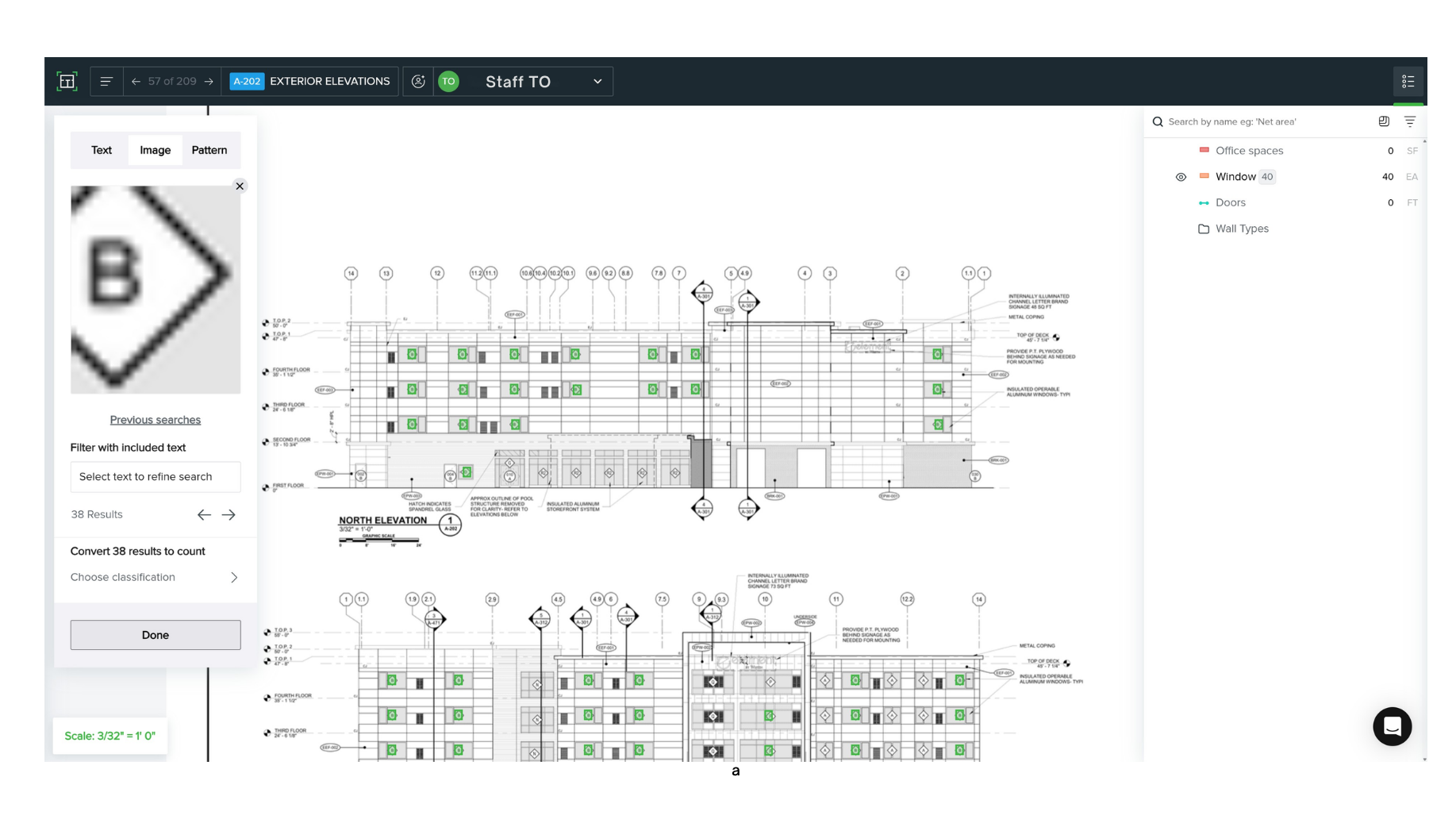
- Image Search lets you box a symbol, for example, a light fixture, and find every instance across the set, like Ctrl+F for drawings.
- Drawing Comparison compares revisions and quantifies what changed.
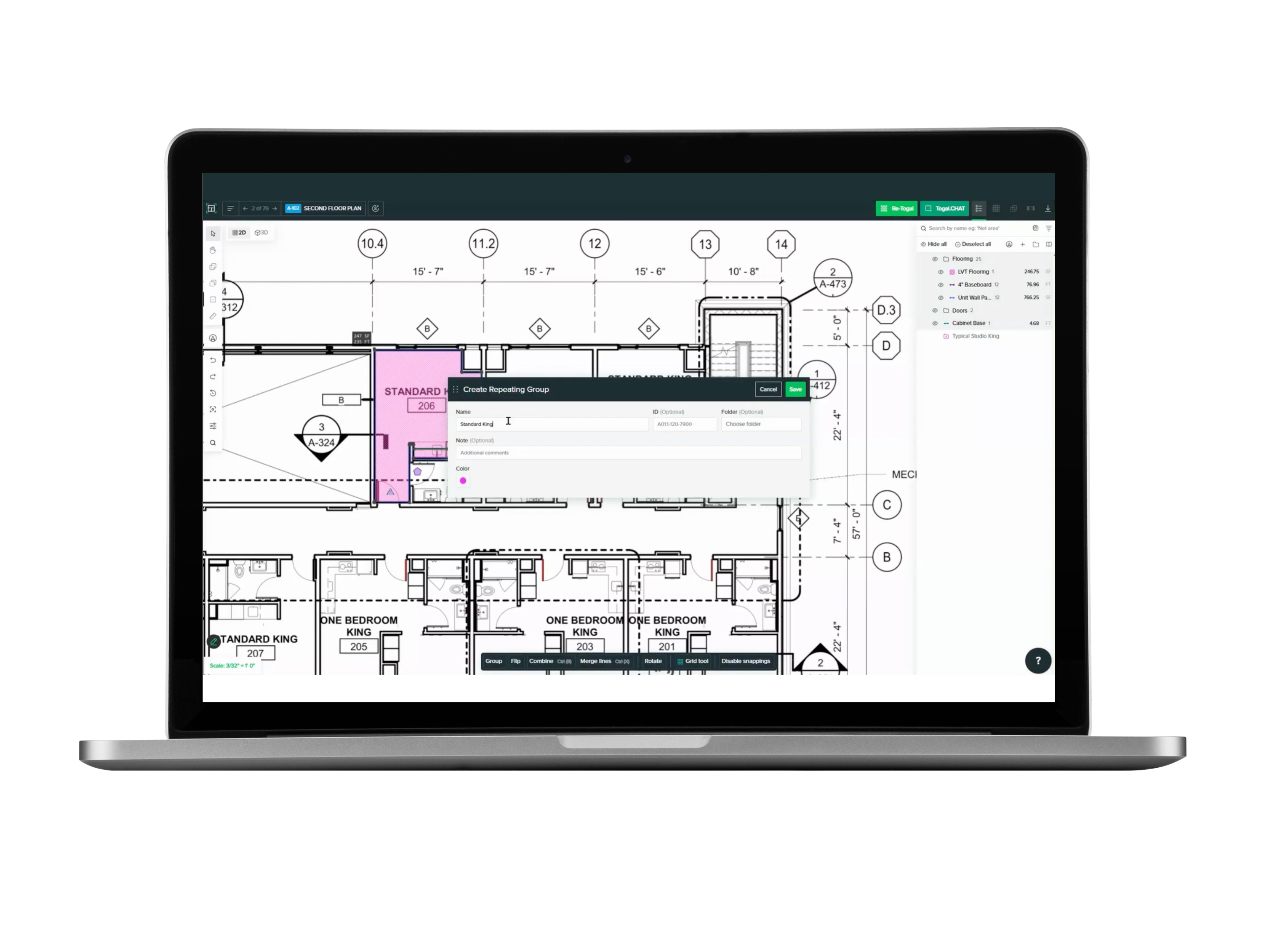
Teams get takeoffs up to 4X faster, and estimator time moves from measuring to reviewing. Togal is takeoff software: quantities export to Excel or move through integrations with Ediphi, Zebel, and ServiceTitan into the system where you build the estimate.
See how Togal runs a takeoff on your own plan set.
Manual vs. Digital Quantity Takeoff Methods: Which Is Faster?
AI-assisted digital takeoff is the fastest of the three on large, repetitive, or frequently revised plan sets, and manual slows down most as the sheet count grows. The table compares where each method puts your hours.
How Each Method Handles Revisions and Cost Control
The first takeoff is only part of the cost. The rest arrives with each new drawing issue, often the third or the seventh, and that is where cost control slips. With manual and click-based methods, you redo the affected work. With AI-assisted takeoff, you compare the two sets and see the deltas.
Coastal Construction, a Florida general contractor whose projects often run past 30 stories, averages seven design iterations per project. With Togal's drawing comparison, Coastal reports 35 to 45% less change tracking time and about 85 hours saved per project.
When quantities keep pace with the design, project stakeholders see a current overall project cost at each stage of the project lifecycle. When they trail the drawings, the risk tends to show up later as cost overruns.
How Do You Choose a Quantity Takeoff Method for Your Project Cost and Team?
Choose based on several factors: bid volume, plan set size, how often revisions arrive, and how many estimators touch one job. Project cost alone is a weak guide, because a small job with constant revisions can take more hours than a large one issued once.
- Choose manual if you bid smaller projects with one scope, few sheets, and rare revisions
- Choose click-based digital if your volume is steady and one estimator owns each bid
- Choose AI-assisted if bid volume drives growth, plan sets run long, or estimators in different offices share a takeoff
Match the Method to the Estimate Stage
AACE International's cost estimate classification system grades estimates from Class 5, the least defined, to Class 1, the most defined. What a takeoff method needs to deliver changes with the stage:
- Early stage (ROM and conceptual): speed supports decision-making. Coastal cut ROM estimates on a typical 28- to 30-story project from 32 to 40 hours to 13 to 20 hours.
- Bid stage: throughput matters. NC Painting, a painting subcontractor, went from 19 to 60 bids a month in under 60 days after switching to Togal, a 215% increase.
"The first sign is the jobs you pass on. From my experience, teams track win rate on the bids they sent, and the invitations they declined for lack of estimator hours never show up in that number. When I was estimating, a heavy bid week meant saying no to good work before anyone opened the drawings."
Johnny Maghzal, Head of Growth at Togal.AI and former estimator
Count Takeoff Hours As Indirect Costs
Estimator time sits in overhead, so your takeoff method shows up in indirect costs before it shows up in a bid. Coastal tracks preconstruction cost as a share of overhead: 27.6% in 2023, 15.2% in 2025, while revenue grew about 84%.
Coastal credits larger projects, process changes, and a sharper pursuit strategy alongside Togal, so the figure reflects the whole operation. It still shows how takeoff hours affect project profitability and resource allocation. If you run several offices, see how takeoff software for general contractors handles shared plan sets.
Book a demo. Bring a live bid and compare it against your current takeoff time.
What Do Estimators Still Own in the Estimating Process?
Software takes over the measuring, but the estimator still decides what the quantities mean. A real person still:
- Classifies elements and sets the naming the export depends on
- Reads for what the drawings leave out
- Accounts for site conditions
- Applies historical data from completed work
Those calls turn quantities into realistic budgets and support value engineering with owners and subcontractors.
Junior estimators still learn that craft, without weeks of clicking every corner first, and review time is where it pays off. Total Flooring Contractors is one example: the team took off a 30-story residential tower in 48 hours instead of two weeks, surfaced costly errors in the drawings before submission, and won the contract.
"I check the counts against the schedules first, starting with doors and finishes. Either they match or they don't, and if they don't, the number doesn't go out until I know why. My name went on that number, so that check stays with the estimator no matter how the counting got done."
Johnny Maghzal, Head of Growth at Togal.AI and former estimator
Frequently Asked Questions
What is the best software for quantity takeoff?
The best quantity takeoff software matches your drawings, bid volume, and team size. For teams with dedicated estimators, long plan sets, or multiple offices, look for AI that detects and measures from PDFs, manual tools behind it, and live collaboration. Togal.AI is built for that workload, with published pricing from $299 per month per seat, billed yearly.
What is the difference between a quantity takeoff and a material takeoff?
A quantity takeoff measures everything the construction works require in net quantities, including labor-driven items and equipment. A material takeoff lists only the physical materials to purchase, usually adjusted for waste. The quantity takeoff comes first and feeds material ordering, labor required, and pricing.
What file types can you use for a digital quantity takeoff?
Most digital takeoff tools work from PDF drawings. Togal.AI also accepts PNG, TIFF, JPEG, and other industry-standard formats, plus maps and image uploads. You can run a takeoff from the plans you already receive.
Takeoff in Minutes. Not Days.
Pick the quantity takeoff method that matches how often your drawings change and how many estimators share a bid. Then run one live bid through it and compare the hours.